LLM-powered Systems
Let’s Dive into LLM AI’s Potential to Automate Work, Jobs majorly Affected and The Next Productivity Frontier
The rise of large language models (LLMs) is transforming how work gets done across industries. From drafting reports to automating workflows, AI systems are rapidly moving from experimental tools to essential workplace infrastructure. Yet new research suggests that despite the excitement surrounding generative AI, we have only tapped a small fraction of its potential to automate work.
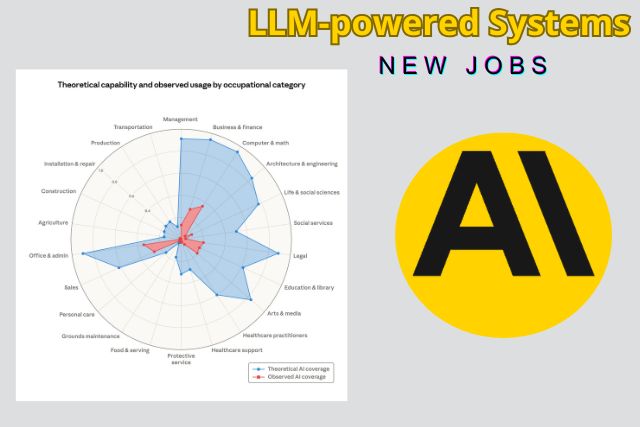
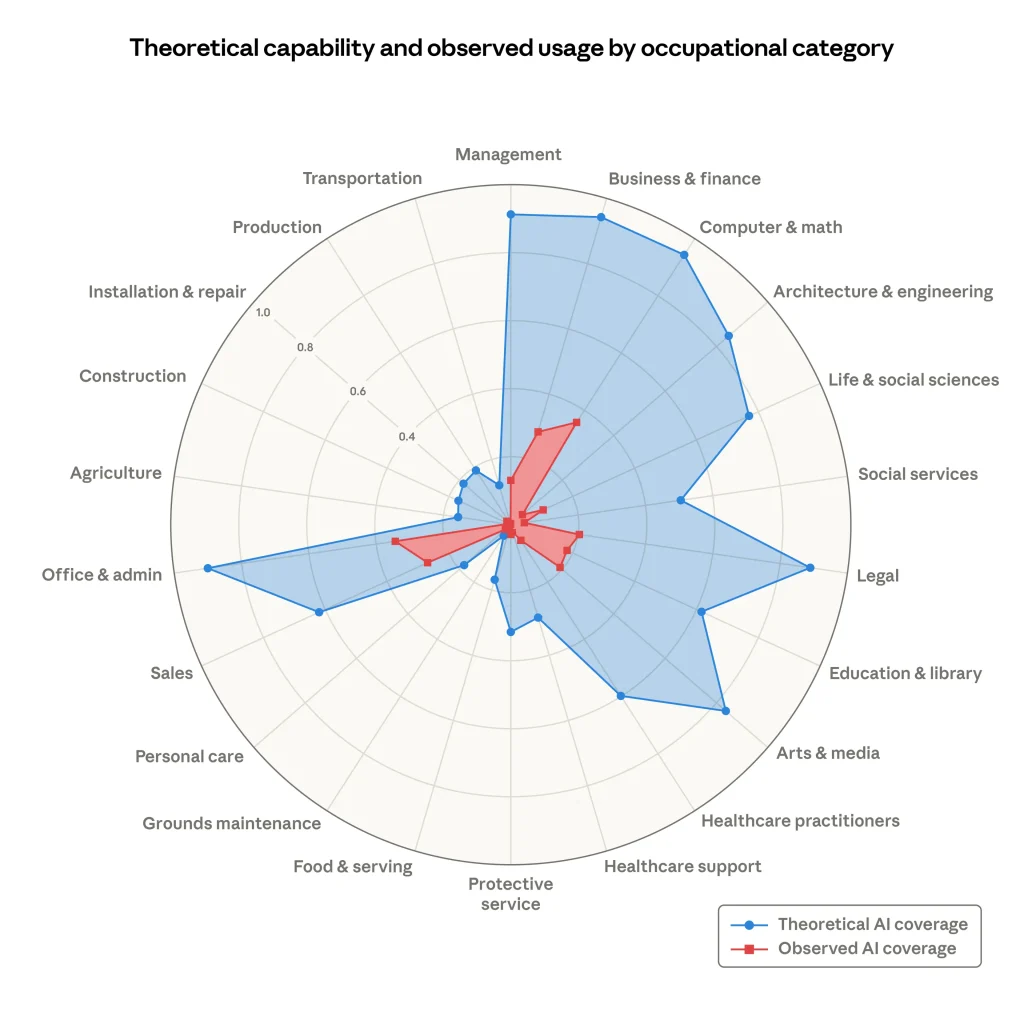
A recent research analysis based on millions of real-world AI conversations reveals a striking gap between what LLMs could theoretically automate and what they are currently used for in professional settings. The visual chart above illustrates this clearly: the blue area represents the theoretical capability of AI to perform job tasks, while the red area shows the actual observed usage today. The difference between these two regions highlights one of the most important insights about the future of work with AI, adoption is still in its early stages.
The Untapped Potential of LLM Automation
Large language models such as those used in advanced AI assistants can already perform many tasks associated with knowledge work. These include summarizing information, writing documents, analyzing data, coding software, and managing communication.
According to recent AI labor research, many occupations have a high theoretical AI coverage. For example:
- Computer and mathematics roles could see over 90% of tasks supported by LLMs in theory.
- Office and administrative work shows around 90% potential task automation.
- Business and finance roles also demonstrate high exposure to AI-powered assistance.
However, actual usage levels are far lower. In some sectors, only about 30% to 35% of tasks currently involve AI assistance, revealing a massive opportunity for productivity gains as adoption increases.
This gap suggests that while the technology is capable, organizations are still learning how to integrate it effectively into daily workflows.
AI Automation in the Workplace Today
Examples of AI in workplace environments are becoming increasingly common. LLM-powered systems are already assisting professionals in several ways:
- Software development: AI can generate code, review bugs, and suggest optimizations. Many programmers use AI assistants as collaborative coding partners.
- Customer service: AI chatbots can handle common inquiries, generate responses, and support human agents.
- Content creation: Marketing teams use generative AI to draft articles, summarize research, and develop campaign ideas.
- Data processing: AI tools can analyze large datasets and produce insights in minutes instead of hours.
Despite these examples, most organizations use AI primarily for augmentation rather than full automation. In other words, AI helps workers perform tasks faster rather than replacing them entirely.
This collaborative approach aligns with the growing idea of AI as a productivity partner, rather than a pure replacement for human labor.
Knowledge Workers Are the Most Exposed
One surprising finding from recent labor market research is that the jobs most exposed to AI automation are not necessarily low-wage roles. Instead, they are often highly educated, higher-paid knowledge workers.
Workers in fields involving writing, analysis, research, or digital communication are more likely to interact with AI tools. These include:
- Programmers
- Financial analysts
- Legal professionals
- Marketing specialists
- Researchers and consultants
In contrast, many physical jobs remain difficult for AI to automate. Roles such as cooks, mechanics, construction workers, and bartenders involve hands-on tasks that require physical interaction with the real world.
This divide highlights a key principle shaping the future of work: AI excels at digital cognition but struggles with physical environments.
The Rise of AI Agents and Workflow Automation
The next major shift in workplace AI will likely come from AI agents capable of managing complex workflows. Instead of simply answering prompts, future systems will coordinate multiple tasks automatically.
For example, an AI workflow agent might:
- Gather information from internal databases
- Draft a project proposal
- Schedule meetings
- Track progress and generate status updates
This kind of end-to-end automation could dramatically increase productivity across industries.
Organizations experimenting with AI workflow LLM systems are already discovering that routine administrative tasks can be handled autonomously, freeing employees to focus on strategic thinking and creative work.
The Economic Potential of Generative AI
Economic research from leading consulting firms suggests that generative AI could unlock trillions of dollars in productivity gains globally. Studies on the economic potential of generative AI describe it as the next major productivity frontier, similar to the impact of the internet or electricity.
Generative AI has the ability to:
- Reduce time spent on repetitive tasks
- Accelerate research and decision-making
- Enhance creativity and innovation
- Improve operational efficiency
When combined with automation platforms, LLMs can power intelligent systems that streamline entire business processes.
However, these gains depend on how effectively organizations adopt and integrate AI into their operations.
Early Labor Market Signals
While the long-term effects of AI on employment are still uncertain, early indicators suggest subtle shifts in hiring patterns.
Some studies have found that hiring for AI-exposed roles among younger workers has slowed slightly since the widespread adoption of generative AI tools. For instance, job entry rates for workers aged 22 to 25 in AI-exposed professions have reportedly declined by about 14%.
This trend may reflect companies experimenting with AI tools before expanding their workforce in those areas.
Importantly, there is no strong evidence of large-scale unemployment caused by AI so far. Instead, the technology appears to be gradually reshaping how work is organized.
Superagency: Humans Working with AI
A powerful concept emerging in discussions about AI and the future of work is “superagency.” This idea suggests that AI does not replace human capability but amplifies it.
When workers combine their expertise with AI assistance, they can achieve outcomes that would be difficult to accomplish alone.
Examples of superagency include:
- Analysts using AI to rapidly evaluate large datasets.
- Writers using AI to brainstorm ideas and refine drafts.
- Entrepreneurs using AI tools to build entire digital businesses.
In this model, humans remain central to decision-making, creativity, and emotional intelligence while AI handles repetitive cognitive tasks.
Why Adoption Is Still Slow
If AI is so powerful, why hasn’t it been deployed everywhere already?
Several factors explain the gap between potential and real-world usage:
- Organizational inertia – Many companies take time to integrate new technologies into existing processes.
- Regulatory and legal considerations – Sensitive industries require human oversight and compliance checks.
- Trust and reliability concerns – Businesses must ensure AI outputs are accurate and safe.
- Workflow redesign – Automation often requires restructuring how teams operate.
Over time, these barriers are likely to decrease as AI tools become more reliable and organizations gain experience using them.
The Future of Work with LLM AI
The future of work will not simply involve humans competing against AI systems. Instead, the most successful professionals will learn how to work alongside AI agents and automation platforms.
Skills that will become increasingly valuable include:
- Managing AI workflows
- Interpreting AI-generated insights
- Strategic decision-making
- Creativity and innovation
- Emotional intelligence and relationship building
As AI takes over routine cognitive work, human strengths will shift toward areas that machines cannot easily replicate.
A Technology That Lets Humans Stay Human
One of the most fascinating aspects of modern AI is that it communicates in natural language. Unlike earlier software tools that required rigid commands, LLMs can understand messy, conversational instructions.
This means people do not need to adapt to machines, the machines are adapting to human thinking.
As AI capabilities continue to grow, the gap between theoretical automation and real-world usage will gradually close. When that happens, the workplace could undergo one of the largest productivity transformations in modern history.
Rather than replacing human workers, LLM AI may ultimately enable people to focus more on what makes them uniquely human: creativity, empathy, collaboration, and imagination.