Kenya’s matatu strike hits Nairobi roads as fuel prices soar to KSh 214/litre. See where Kenya ranks in Africa’s top 15 highest fuel prices and what must change.
Nairobi, May 18, 2026 Commuters across Kenya woke up to empty roads on Monday, as matatu operators launched a nationwide transport strike in protest over soaring fuel prices. Hence, leaving hundreds of thousands stranded along major arteries including the Thika Superhighway, Kangemi, Ongata Rongai, and Kitengela. The strike, coordinated by the Transport Sector Alliance, has brought Nairobi and several county towns to a near-standstill. Thus, underlining the urgent economic pressure that rising fuel prices are placing on operators, households, and the wider Kenyan economy.
Where Kenya Stands on Africa’s Fuel Price Map
Kenya is not alone in its struggle. Across Africa, fuel prices have surged sharply in 2026, driven by the ongoing Iran conflict and disruptions to oil supply through the Strait of Hormuz. As one of the world’s most critical energy transit routes. The ripple effects have been immediate and severe for fuel-importing nations across the continent.
In East Africa, the pressure is especially acute. According to the latest GlobalPetrolPrices data, Tanzania is paying approximately $1.59 per litre for petrol, while Rwanda has climbed to $2.01 per litre. The third-highest price in Africa. Across the continent, Malawi holds the unenviable top position at a staggering $3.83 per litre, more than 200 percent above the global average. Then followed by Zimbabwe at $2.08 and the Central African Republic at $1.88.
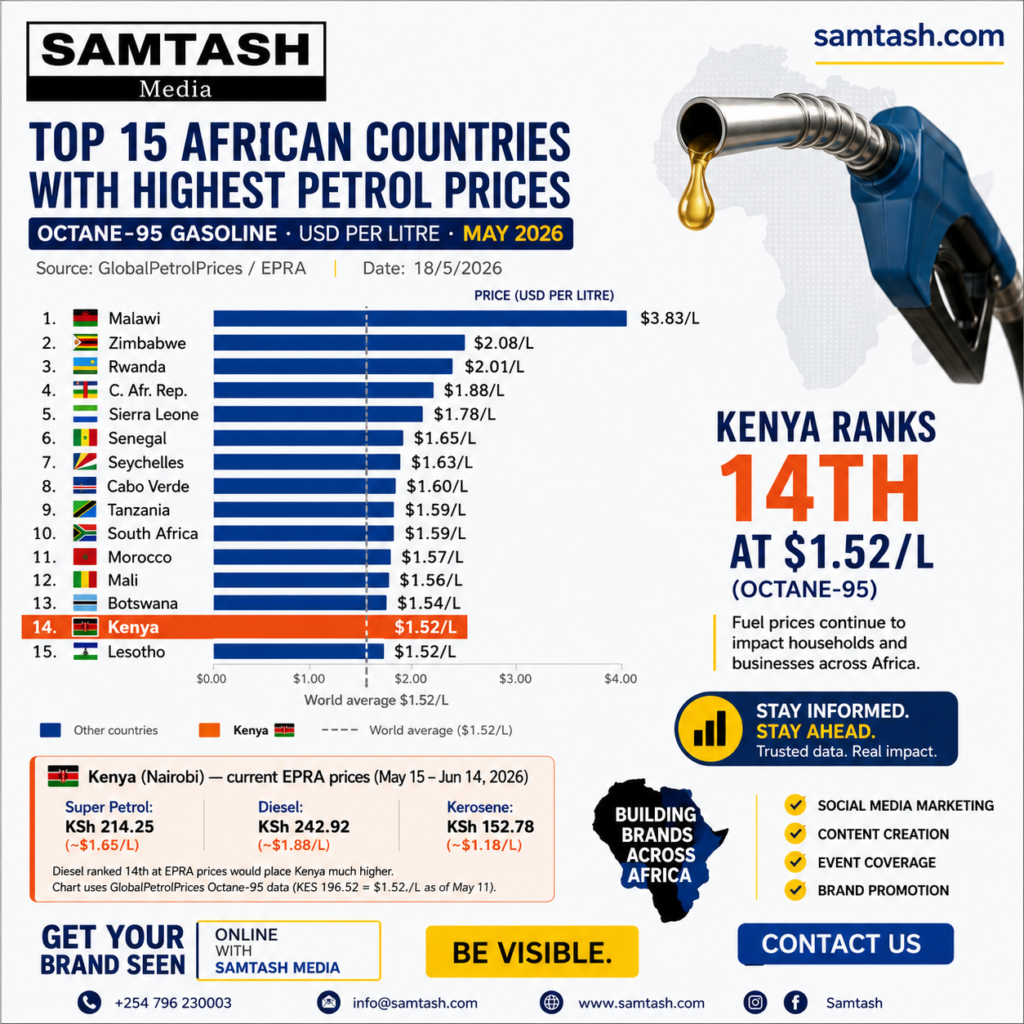
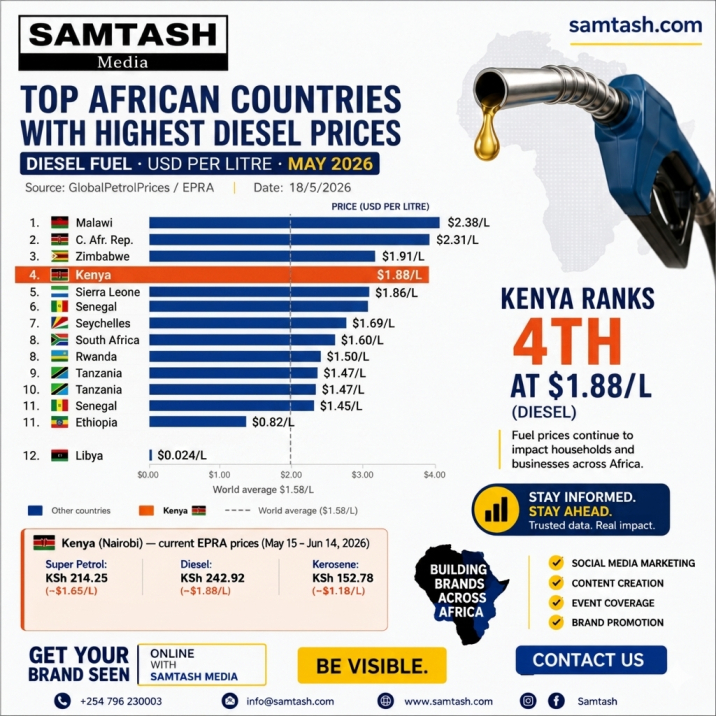
In Kenya, the Energy and Petroleum Regulatory Authority (EPRA) announced new pump prices for the May 15 to June 14, 2026 cycle. In Nairobi, Super Petrol now retails at KSh 214.25 per litre, Diesel at KSh 242.92 per litre, and Kerosene remains unchanged at KSh 152.78 per litre. Super Petrol rose by KSh 16.65 while Diesel surged by KSh 46.29, one of the steepest single-cycle diesel increases in recent memory. Kenya imports all its refined petroleum products, meaning every fluctuation in global oil markets translates directly to the pump.
The Matatu Strike and Its Ripple Effects
The matatu strike, which took effect on Monday morning, is a direct response to these spiralling costs. Operators argue that the fuel price hikes have made running public service vehicles economically unviable without a corresponding adjustment in fares. Thus, a move that would itself deepen the cost-of-living burden on ordinary Kenyans who rely on matatus as their primary mode of transport.
Cabinet Secretary John Mbadi responded firmly, stating the strike was “completely uncalled for,” adding that fuel prices would be even higher without government interventions. EPRA confirmed that the government has deployed approximately KSh 5 billion from the Petroleum Development Levy (PDL) Fund to subsidise diesel and kerosene prices in the current cycle. As a cushion that has demonstrably kept pump prices below what unregulated market rates would produce.
The disruption, however, is real. Workers have been unable to reach jobs. Supply chains face delays. Schools, businesses, and essential services are operating under significant strain. All on a Monday, the most economically active day of the working week.
A Path Forward: What Can Be Done
The matatu strike exposes a deeper structural challenge, but there are actionable solutions. First, Kenya can accelerate investment in compressed natural gas (CNG) and electric public transport, reducing the sector’s vulnerability to imported crude oil prices. Nairobi already has pilot CNG matatu routes, and scaling these meaningfully would insulate operators from global oil shocks.
Second, strengthening the PDL subsidy framework with a transparent, rules-based mechanism, rather than reactive ad hoc interventions. This would give operators greater pricing predictability. Operators can plan and sustain services when they can forecast costs.
Third, regional cooperation matters. East African governments; Kenya, Tanzania, Rwanda, and Uganda can coordinate bulk crude purchasing agreements and shared refining infrastructure to reduce per-country import costs. Hence, lowering the exposure of East Africa’s fuel prices to international market volatility.
The road ahead requires honest dialogue between government, transport operators, and commuters. High fuel prices are a global reality right now, but Kenya’s response to them smart subsidies, cleaner fuel alternatives, and regional energy partnerships. This will define whether its economy absorbs the shock or is paralysed by it.