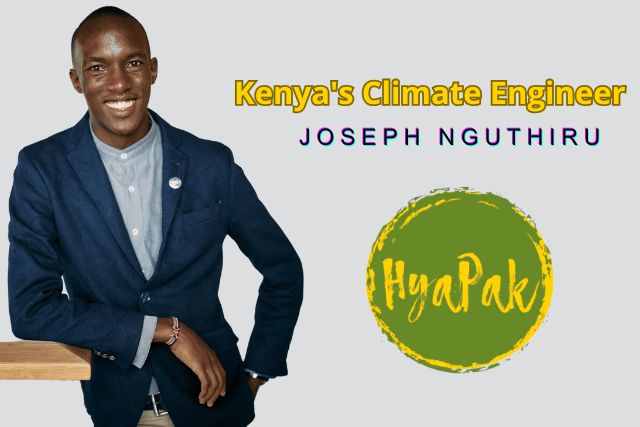
Joseph Nguthiru HyaPak
Joseph Nguthiru Kenya’s 27-Year-Old Climate Engineer Is Turning a Deadly Weed Into the Future of Packaging.
“Ladies and gentlemen, this is the future of packaging.” These are not the words of a seasoned corporate executive or a veteran environmentalist with decades behind a podium. They belong to Joseph Nguthiru, a 27-year-old Kenyan climate-tech engineer. Who has quietly built one of the most compelling eco-innovation stories to emerge from Africa in recent years. Through his startup, HyaPak Kenya, Nguthiru is transforming water hyacinth. The world’s most invasive aquatic weed, into biodegradable packaging that looks, feels, and performs like plastic, without any of the environmental cost.
Who Is Joseph Nguthiru?

Joseph Nguthiru is a 27-year-old climate-tech engineer from Kenya who has turned one of the country’s most persistent environmental problems into a green business model. Growing up near Kenya’s lakeside communities, he witnessed firsthand how water hyacinth was suffocating waterways, strangling fishing livelihoods, and degrading ecosystems. Rather than viewing the weed as an insurmountable obstacle, Nguthiru saw an opportunity, one that would ultimately take him to the global stage.
As founder and CEO of HyaPak, Nguthiru has built his company around a single, powerful idea: use one environmental problem to solve another. His company converts the invasive water hyacinth from Lake Naivasha into biodegradable packaging bags and seedling wrappers. Hence, replacing single-use plastic products while making agricultural lands healthier and offsetting CO₂ emissions.
Joseph Nguthiru Age and Background
Joseph Nguthiru’s age 27, makes his achievements all the more remarkable. He is a trained climate-tech engineer who chose to apply his skills not in a laboratory or a corporate tower. But in the fishing communities surrounding Lake Naivasha, where the crisis was most acute. His engineering background gave him the tools to identify a scientific solution, but it was his deep connection to his community that gave him the drive to pursue it.
When Kenya banned single-use plastic bags, a policy widely praised for its environmental intent. The country was left without practical, affordable alternatives. Nguthiru identified this gap and set to work filling it with something grown right on Kenyan soil, or more precisely, on Kenyan water.
HyaPak Kenya Eco-Friendly Innovation Reshaping Packaging
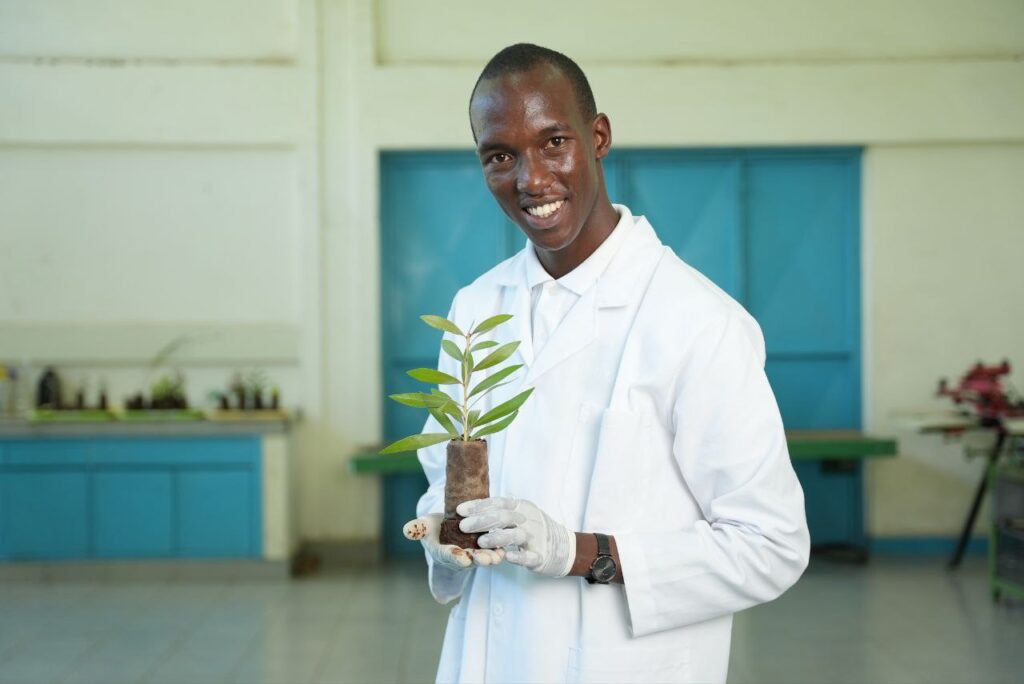
HyaPak Kenya is not a concept or a pilot programme. It is a functioning, scaling business rooted in scientific rigour and community partnership. The HyaPak water hyacinth eco-friendly innovation works through a carefully engineered process: after the hyacinth is harvested and dried by local fishermen at Lake Naivasha, it is transported to HyaPak’s facility in Nairobi, where it is crushed into an extremely fine powder. Cellulose is then extracted from this powder and converted into a pulp material used for a range of packaging applications.
The products that result are extraordinary in their mimicry of conventional plastic. They are flexible, durable, and functional. Yet they decompose naturally at the end of their lifecycle, releasing no harmful microplastics into the soil or water. One particularly innovative product is a biodegradable seedling wrapper that can be planted directly into the soil alongside the seedling. As it decomposes, it releases nutrients that actively accelerate plant growth. Another application involves food transport linings that keep produce fresh over long distances without refrigeration.
This is the HyaPak water hyacinth eco-friendly innovation in practice: circular, community-driven, and built for scale.
Green Jobs and Community Impact
Beyond the product itself, what distinguishes HyaPak Kenya is its deliberate investment in the communities that bear the greatest cost of the water hyacinth crisis. Nguthiru has structured his supply chain so that local fishing communities are partners in the harvest. Thus, earning income from a weed that once robbed them of their livelihoods. According to Nguthiru, HyaPak has already created over 45 green jobs for these communities. People who are now paid to manage and harvest the very weed that once blocked their fishing routes, disrupted irrigation, and bred the mosquitoes responsible for malaria outbreaks.
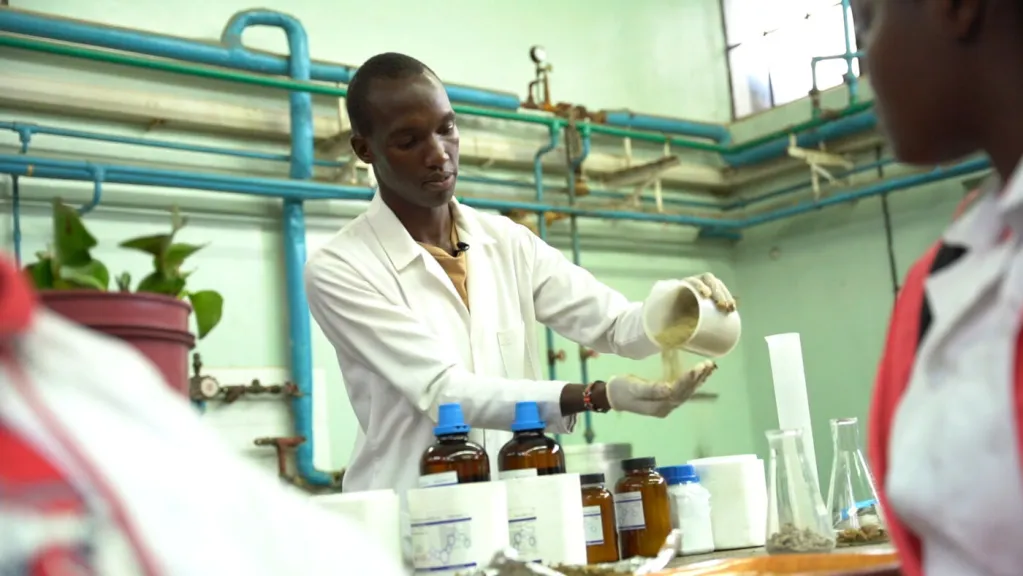
This model. Transforming environmental adversity into economic opportunity, is precisely why HyaPak Kenya has drawn global attention.
The UNEP Young Champions of the Earth Award
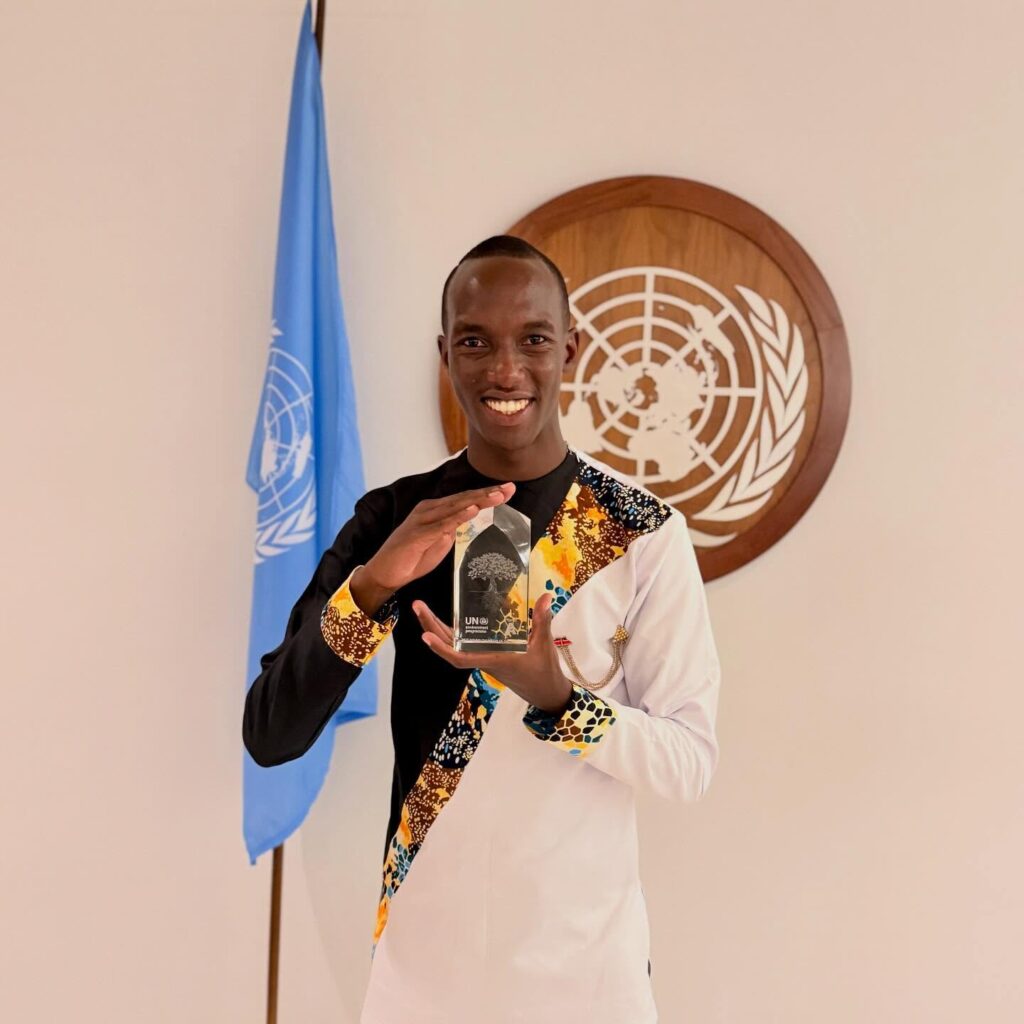
On September 23, 2025, the UN Environment Programme named Joseph Nguthiru one of three winners of the 2025 Young Champions of the Earth prize. Alongside India’s Jinali Mody and American innovator Noemi Florea. Noemi Florea, aged 24, is the founder of Cycleau, a compact greywater reuse system that retrofits under sinks, showers, and laundry units to convert wastewater into safe drinking water, using significantly less energy than conventional treatment methods.
Each winner received US$20,000 in seed funding, mentorship, and communications support. Along with a global platform to showcase their solutions and scale their impact across communities and industries. But Nguthiru did not stop there. He went on to win an additional $100,000 grant from the Planet A pitch competition. A contest held alongside the UNEP ceremony that gave winners the chance to secure major business growth funding.
Joseph Nguthiru Net Worth
Joseph Nguthiru’s net worth is not a figure that has been publicly disclosed, and that is perhaps fitting. His is a mission-driven enterprise still in its growth phase, and the metrics that matter most to Nguthiru appear to be environmental and social rather than financial. What is clear is that the combination of UNEP seed funding, the $100,000 Planet A grant, international recognition, and a commercially viable product places HyaPak Kenya on a strong trajectory. As demand for sustainable packaging accelerates globally, the commercial upside for HyaPak is substantial.
A Blueprint for Africa and the World
Joseph Nguthiru’s story carries a message that resonates far beyond Kenya’s lakeshores. He has demonstrated that the most powerful environmental solutions are often the ones that emerge from the communities most affected by the problems. His advice to young people is direct:
“Don’t be afraid to start small. Don’t be afraid to think big.”
In a world drowning in single-use plastics and struggling to find scalable green alternatives, HyaPak Kenya and the young engineer behind it, offers something rare: a solution that is already working.