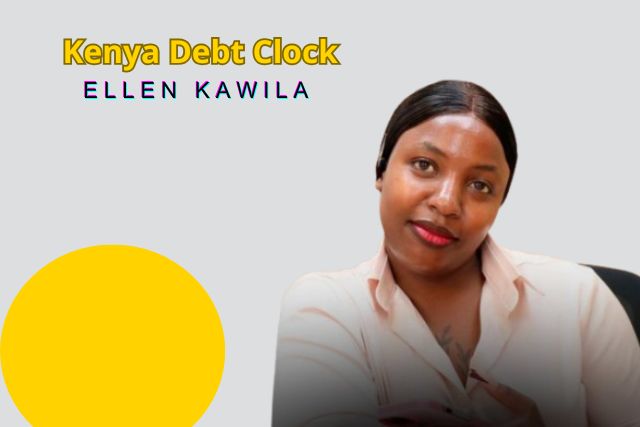
Ellen Kawila, Kenya Debt Clock
Meet Ellen Kawila, The alleged 25-Year-Old Gen Z Turning Kenya’s National Debt Into a Living, Breathing Number
Every second, Kenya’s national debt grows. Most citizens never see it happen. Ellen Kawila is changing that.
For years, billions of shillings in public funds have vanished into procurement scandals, stalled infrastructure projects, and unresolved audit queries.
One young woman from the Kenyan coast has decided that opacity is no longer acceptable, and she has built the tool to prove it.
Ellen Kawila, a 25-year-old Gen Z civic educator from Kilifi County, has created the Kenya Debt Clock. An innovative online platform that visualises the country’s debt burden in real time.
Notably, drawing on publicly available data from institutions including the Central Bank of Kenya, the National Treasury, the International Monetary Fund, and the World Bank.
Tick by tick, the platform counts upward, translating complex national finance into a single, undeniable reality that any Kenyan can witness from a phone screen.
From TikTok Educator to Civic Tech Innovator
Kawila did not set out to build financial technology. Her path began on TikTok, where she established herself as a civic educator simplifying public policy for young Kenyans.
Her digital presence gained significant attention in 2024 when she publicly called out police brutality during the June 25th demonstrations. Hence, a turning point that deepened her commitment to accountability and transparency.
She traces her civic awakening directly to the Finance Bill 2024 protests, which politically activated a generation of young Kenyans frustrated by unemployment and a rising cost of living.
She began creating content specifically because young people urgently needed civic education, and the movement’s defining characteristic, she noted, was its lack of central leadership.
Especially, driven instead by ordinary citizens who recognised themselves as taxpayers equally affected by government decisions.
That philosophy, everyone is a stakeholder, became the philosophical backbone of the Kenya Debt Clock.
Reading the Numbers No One Wanted to Read
After the protests subsided, Kawila went further. She began consuming government audit reports, county expenditure documents, and public finance records with methodical discipline.
What she found alarmed her. County budgets, she observed, were consuming between 60 and 70 percent of their allocations on salaries alone. Thus, leaving minimal room for development expenditure that ordinary citizens could feel in their daily lives.
She asked the question many had quietly wondered: if the bulk of public money pays for the public sector itself, when does it pay for the public?
It was this frustration, grounded in documented evidence rather than speculation, that gave rise to the Kenya Debt Clock.
The platform accounts for project-specific borrowing tied to major national infrastructure, including the Talanta Stadium, the Standard Gauge Railway, and Thika Road.
It also translates these complex financial systems into a simple, constant, and publicly accessible reality.
What the Clock Actually Shows
The Kenya Debt Clock does more than display a rising number. It breaks down Kenya’s borrowing patterns, tracks daily interest accumulation, calculates how much debt each Kenyan citizen.
Notably, including every newborn child, carries the moment they enter the world, and aggregates the cost per household.
The platform also documents specific financial scandals, including irregularities in the National Hospital Insurance Fund (NHIF), the Arror and Kimwarer dam projects, and missing funds from the Constituency Development Fund kitty.
The platform draws from the Central Bank of Kenya’s December 2025 report, the 2026 Budget Policy Statement, Kenya National Bureau of Statistics data, and Auditor-General records.
Also with full methodology and sources listed publicly for verification.
Kawila acknowledges openly that the figures are estimates, noting that not all lenders or institutions have disclosed complete information. The platform is updated continuously as new data becomes available.
The server hosting the Kenya Debt Clock is deliberately based in the United States. A security decision Kawila made out of concern that the platform could face interference within Kenya.
Despite these precautions, she reports that there have been attempts to access and disrupt the system’s programming, none of which have succeeded.
A Demand, Not Just a Dashboard
For Kawila, the Kenya Debt Clock is not simply a data visualisation exercise. It is a civic demand addressed to the executive, the legislature, and the Senate.
The elected representatives she believes must be confronted daily with the consequences of continued borrowing.
Her message is direct: international lenders placing Kenya on a red bar is not a technical matter for technocrats alone. It is a political and moral failing that voters have the right to witness in real time.
Describing the current wave of civic mobilisation around public finance, Kawila put it plainly: “This is a civic education exercise because all of us are taxpayers and all of us are affected.”
At 25, Ellen Kawila has reframed what civic participation looks like in the digital age.
She has shown that the most powerful political act can sometimes be simply making the truth visible, one second at a time.
The Kenya Debt Clock is accessible online at kenyadebtclock.com.