Tonee Ndungu NAFSA Orlando
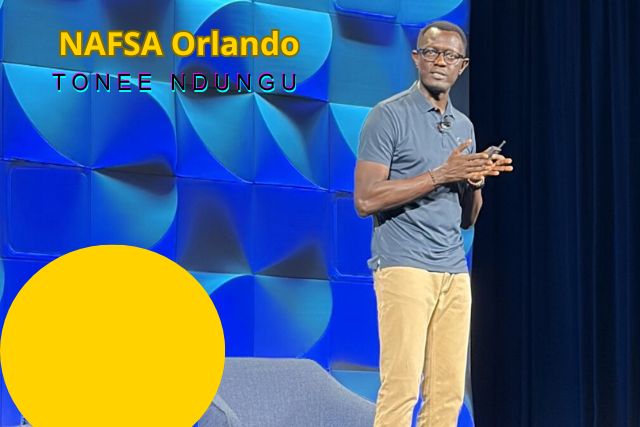
Kenyan tech founder Tonee Ndungu keynoted NAFSA Orlando 2026, calling for inclusive, AI-powered education systems that put Africa at the centre of global learning.
The Nairobi-born founder of Kytabu and Tribbe Nation told the world’s largest gathering of international educators, that the future of learning must be designed with everyone or it will fail everyone.
When Tonee Ndungu walked onto the stage at the NAFSA Annual Conference in Orlando, Florida. He carried with him something that most keynote speakers at international education summits rarely bring: the lived reality of building technology from scratch in Africa, for Africa, and now, unmistakably for the world.
NAFSA: Association of International Educators is the largest professional development organization in the world dedicated to international education.
Its annual gathering draws thousands of educators, policymakers, and institutional leaders. This year, the Kenyan serial entrepreneur, Eisenhower Fellow, and Silicon Savannah pioneer used that platform to make a case that is both urgent and straightforward.
The future of education is being shaped right now, in real conversations, and Africa must be at the table. Notably, not as a footnote, but as a co-author.
From Nairobi to Orlando, a message built over decades
Tonee Ndungu is not a newcomer to global stages. He has addressed the United Nations, spoken at the G7, held conversations at the Obama White House, and shared a room with figures from Sam Altman to Bill Gates.
But his keynote at NAFSA Orlando distilled something more personal than any of those appearances: a philosophy of inclusion forged through his own experience growing up in Nairobi with dyslexia.
Hence, finding his way through high school with a Walkman and recorded textbooks, and going on to build foundational technology platforms that now serve millions.
That backstory is not incidental. It is the engine of his argument. Talent, he told the NAFSA audience, is universal. Opportunity is what is unevenly designed.
And in an era where artificial intelligence is rapidly making intelligence itself accessible to anyone with a device and a data connection, the old excuses for exclusion are running out of runway.
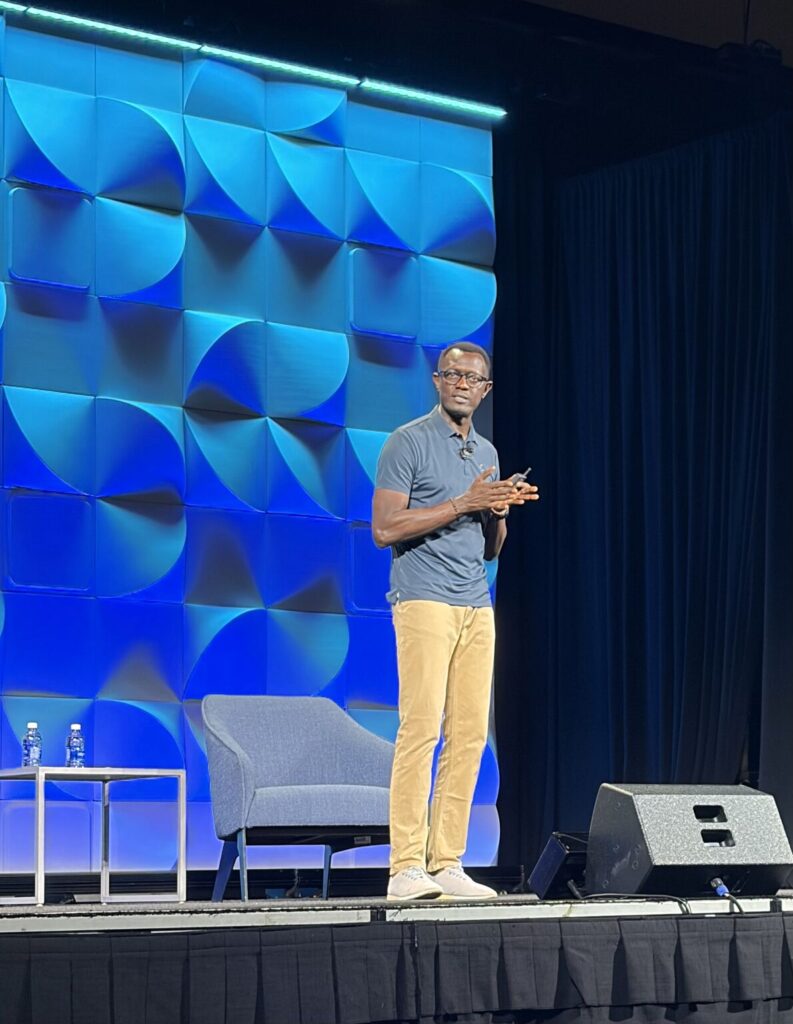
“The future of education will be designed by those who we choose to include. I implore you to include everyone.” — Tonee Ndungu, NAFSA Annual Conference, Orlando 2026
AI, agency, and the African demographic dividend
The numbers Ndungu placed before the NAFSA audience are difficult to ignore. Africa is home to more than 500 million people under the age of 21.
Kenya alone has roughly 50 million people and an equivalent number of students, and the country ranks as the top ChatGPT user per capita on earth.
While much of the world’s population is ageing, Africa is accelerating in youth, in connectivity, and in demand for educational infrastructure that actually serves its people.
His argument at NAFSA Orlando was not that AI will solve education. It was more nuanced, and more demanding. Technology, he said, should not replace humanity in education.
It should help us understand it better. The systems educators build must respond to context, identity, talent, and lived reality. Standardisation is not the answer when the students arriving at the door of the future are anything but standard.
Ndungu has lived this tension as a founder. His edtech platform Kytabu, which digitised textbooks for thousands of Kenyan students and teachers, competed in the same market that ChatGPT disrupted practically overnight between late 2022 and early 2023.
Rather than retreat, he adapted co-architecting Tribbe Nation, a fintech platform digitising community savings and credit, and continuing to build AI and technology infrastructure across the continent.
A call to redesign the table, not just expand the chairs
What made Ndungu’s presence at NAFSA Orlando significant was not only what he said, but what his being there represented.
International education has long discussed Africa as a destination for outbound mobility programmes or as a recipient of development-funded initiatives.
Ndungu’s keynote quietly but firmly repositioned that frame. Many of the questions global education is wrestling with today, around access, affordability, mobility, and relevance.
These are questions Africa has lived with and worked on for decades. That experience is not a gap. It is a contribution.
Reflecting on the conference, Ndungu expressed gratitude to NAFSA CEO Dr. Fanta Aw and the wider team for creating the space for those conversations and for extending an invitation.
He noted from Nairobi afterward, sent much love back across the Atlantic.
What comes next from Silicon Savannah
Tonee Ndungu returns to Nairobi not as someone who spoke to the world about Africa’s potential, but as someone who is actively building it.
Through Kytabu and Tribbe Nation, through mentorship at the Nailab Tech Hub and the broader Silicon Savannah ecosystem he helped create.
Thus, through an increasingly global platform, he continues to operate from the principle he has articulated consistently across every stage he has stood on. As the systems we build must reflect the people they are meant to serve.
At NAFSA Orlando in 2026, he asked one of the world’s most influential gatherings of educators to hold that standard.
The question now is whether the institutions of international education will take up the design challenge he has placed before them, and whether they will build with Africa, not just for it.