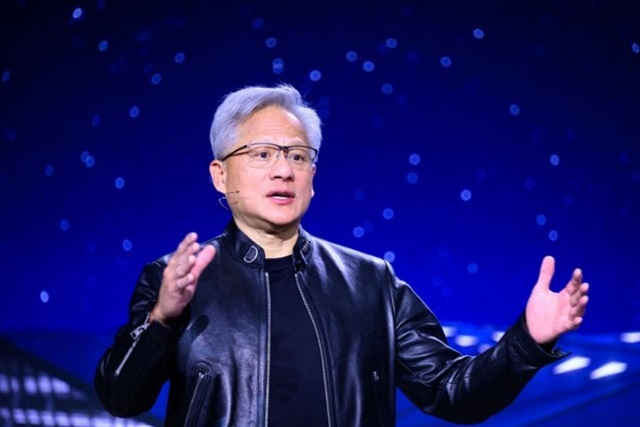
Jensen Huang on The Future of Computing, AI & What’s Next
At Dell Technologies World 2026, NVIDIA’s CEO laid out a sweeping vision for the agentic era.
AI has crossed from novelty into utility, and computing demand is growing at a pace the industry has never seen.
When Jensen Huang takes the stage, the technology industry listens. At Dell Tech World 2026, the NVIDIA founder and CEO delivered one of his most consequential public addresses yet.
A detailed, unambiguous declaration that artificial intelligence has finally arrived as a genuinely useful force in enterprise computing. And that the infrastructure race to support it is only accelerating.
“We’ve now arrived at the era of useful AI. Until now it’s been novel, interesting, incredibly exciting but really, at the enterprise level, the actual use was minimal. Now it’s taken off.”
Those words carry particular weight coming from Huang, whose views on AI have consistently shaped investor sentiment, enterprise strategy, and national technology policy.
The NVIDIA CEO has spent years building toward this moment, and by his own account, the results are now showing up everywhere.
From generative to agentic fundamental leap
Huang traced the arc of AI’s evolution with characteristic clarity. Two years ago, the conversation centred on generative AI, systems capable of producing content.
That era gave way to reasoning, then planning, and finally to fully agentic systems: autonomous AI workers that use tools, evaluate results, iterate, and complete complex multi-step tasks without continuous human direction.
The computational implications are staggering. Where a simple query once required modest processing power, agentic systems may run autonomously for days or weeks.
Huang cited software programming tasks that NVIDIA’s own agents now complete in a week. Work that would have taken an entire human team a month.
As a result, compute requirements per task have grown by a factor of 100 to 1,000, while the number of people and organisations deploying agents has simultaneously surged. The combined effect on demand, he noted, has been nothing short of parabolic.
Huang outlined how the modern AI stack functions in practice: a massive frontier language model.
Potentially holding one trillion parameters operates as the central brain, while a CPU-based harness running a governed sandbox orchestrates the agent’s moment-to-moment work.
Local models handle sensitive tasks on-premises; cloud-scale systems handle the heavy lifting. This hybrid architecture, he argued, is the only approach that delivers both performance and data sovereignty for enterprise customers.
The Five-Layer Cake Huang’s blueprint for AI infrastructure
For those tracking Jensen Huang’s AI layers framework, Dell Tech World offered a vivid illustration of how each level connects.
Energy and chips form the foundation; infrastructure, models, and applications rise above them. NVIDIA’s own Vera CPU designed specifically for the token-generation economics of the AI era rather than the core-rental economics of traditional cloud computing.
Hence, exemplifies how each layer is being purpose-built for this new paradigm.
Vera, Huang explained, achieves three times the memory bandwidth of the world’s fastest existing CPU and delivers the highest single-threaded performance available today.
Those are not incremental improvements. When agents query databases thousands of times per task, CPU bottlenecks directly limit the speed of AI output, and therefore the productivity gains AI is supposed to deliver.
“One really good engineer today is working with an agent. A really great engineer in the future is going to be orchestrating a whole bunch of agents orchestrating sub-agents to do work.”
A partnership decades in the making
The conversation between Huang and Dell CEO Michael Dell was punctuated by genuine warmth, the two have worked together for 31 years.
Standing beside a towering GB300-based PowerRack server that Huang graciously autographed on stage, the pair compared it to the desk-side workstation nearby: the same architecture, but 100 times the scale, capable of running a one-trillion-parameter AI model as a single self-contained system.
A year ago, such a machine would have been described as a cloud data centre. Today it ships as a product.
The milestone moment illustrated the pace of change that Huang has been describing in his public communications and keynotes: what took months now takes weeks; what took weeks now takes days. Tasks that once filled an afternoon are now expected instantly.
A reality check grounded in results
Sceptics looking for a Jensen Huang AI reality check will find it embedded in the specifics he shared. This is not a vision of AI productivity gains years away.
NVIDIA’s own engineering teams are already deploying agents across software development, DevOps, CI/CD pipelines, and QA testing at scale.
Enterprise customers including Lilly, Samsung, and Honeywell. They are restructuring workflows and committing to agentic deployments in earnest. The shift from pilot to production is underway.
Consistent with his remarks at Davos earlier this year, Huang framed AI not merely as a productivity tool but as essential national infrastructure. As foundational as roads or electrical grids.
His argument: because AI dramatically lowers the barrier to problem-solving and wealth creation, every country and every company has a strategic imperative to build its own AI ecosystem, trained on its own data.
The personal dimension
And those ambitions are now very large indeed. “How high is up?” Huang asked the Dell Tech World audience, before answering with a grin: “Pretty high.”
Given that Jensen Huang’s net worth now reflects a company whose market capitalisation has surpassed most nations’ GDP, the confidence is arguably earned.
The age of useful AI has arrived. The architecture of computing is being reinvented in real time. And Jensen Huang, by every available measure, intends to be at the centre of what comes next.