African startups to watch 2026
Dive into the top 15 African startups to watch in 2026 from Bloomberg’s list, including how much each has raised and the problems they’re solving across Africa.
Africa’s startup ecosystem is entering a defining chapter, and the numbers prove it.
Bloomberg’s second annual Bloomberg Africa Startups to Watch list, published on May 28, 2026, identifies 25 privately held companies racing to solve the continent’s most pressing challenges.
From healthcare access in Chad to drone-based border security in Nigeria. Selected by Bloomberg editors and Bloomberg Intelligence analysts based on problem scale, originality, and investor traction.
The list is a snapshot of where Africa startup news is heading.
What makes this year’s list especially significant is a structural shift in how these companies are funded: nearly half of the capital raised by companies on the list came from African investors.
A sharp departure from the era when international venture capital dominated early rounds. Startups Africa is no longer just a story for outside observers; local capital is now a leading actor.
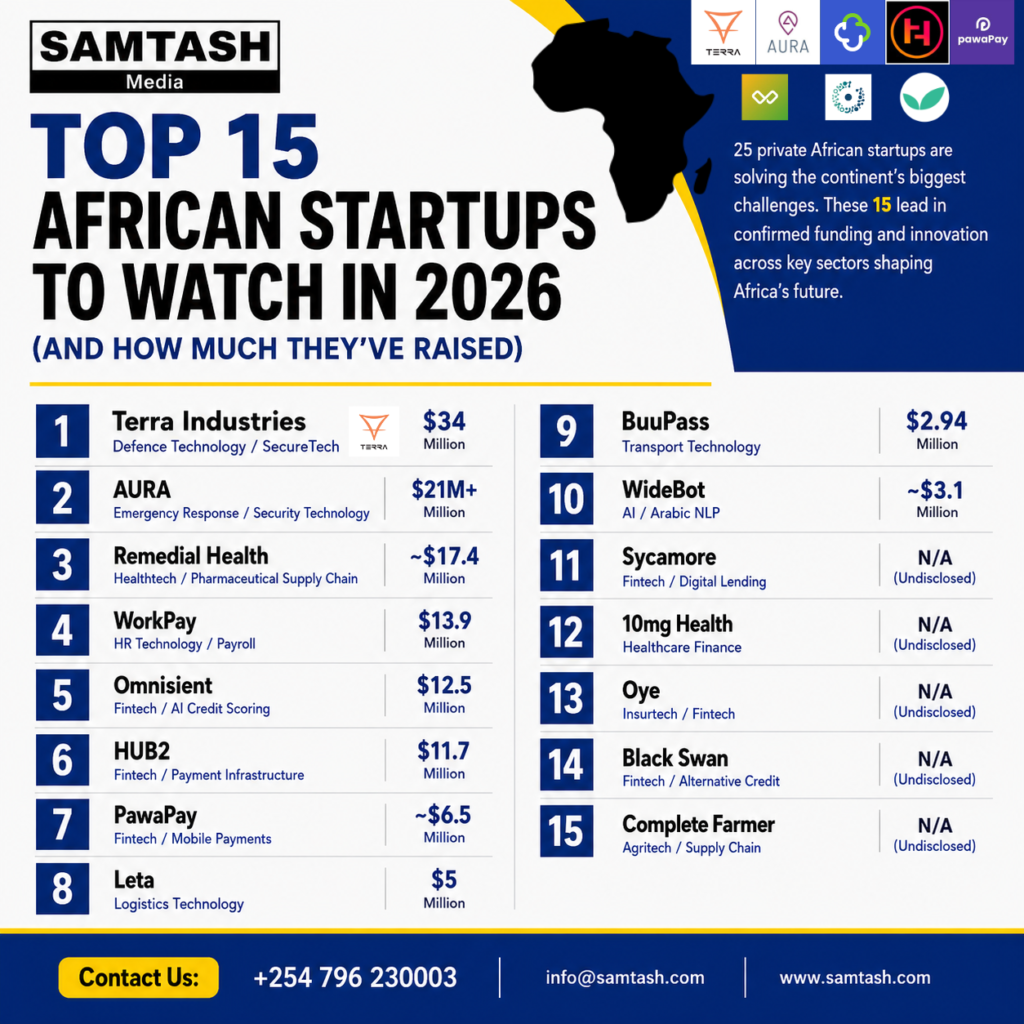
Here are the Top 15 top startups in Africa from Bloomberg’s 2026 list, ranked by confirmed funding raised.
Top 15 top startups in Africa
1. Terra Industries ~$34 Million (Nigeria 🇳🇬)
Sector: Defence Technology / SecureTech
No startup on this year’s list has raised more or attracted more eyebrows. Founded in 2024 by Nathan Nwachuku and Maxwell Maduka, Terra Industries builds mid-range unmanned aerial systems and defence technologies to counter the growing threat of jihadist drone attacks across West Africa’s Sahel region.
The Lagos-based company has raised $34 million across two rounds, backed by 8VC, The venture firm tied to Palantir co-founder Joe Lonsdale, and is currently expanding its manufacturing footprint with a second factory in Ghana.
Terra Industries is a vivid example of how Disrupt Africa’s most urgent problems are creating entirely new investment categories.
2. AURA ~$21 Million+ (South Africa 🇿🇦)
Sector: Emergency Response / Security Technology
Founded in 2017 by Warren Myers and Ryan Green, AURA connects users to vetted private security and medical emergency responders through a single mobile platform.
With over 1.2 million users across South Africa, Kenya, the UK, and the US, the company has raised over $21 million in total, including a €13.5 million (~$14.5M) Series B co-led by Partech and Cathay AfricInvest Innovation Fund in 2025.
AURA now targets expansion into 50 countries within two years, filling a gap left by overburdened public emergency services globally.
3. Remedial Health ~$17.4 Million (Nigeria 🇳🇬)
Sector: Healthtech / Pharmaceutical Supply Chain
Founded in 2021 by Samuel Okwuada and Victor Benjamin, Remedial Health digitises Nigeria’s pharmaceutical supply chain, helping over 14,000 pharmacies and hospitals manage inventory, verify suppliers, and access financing.
To date, the YC-backed company has helped finance over $40 million worth of medicine. Its total funding of ~$17.4 million spans a pre-seed (2022), a $4.4M seed, and a $12M Series A co-led by QED Investors.
Also with backing from Tencent, Y Combinator, and Ventures Platform. It is among the most compelling Africa Tech Startup Forum conversations of the decade.
4. WorkPay ~$13.9 Million (Kenya 🇰🇪)
Sector: HR Technology / Payroll
Founded in 2019 by Paul Kimani and Jackson Kungu, WorkPay started as a payroll tool and has evolved into a full HR, compliance, and financial services platform now operating across more than 30 African countries.
The company has raised $13.9 million across six rounds, most recently an $8.82M Series A led by Norrsken22, with participation from Visa, Y Combinator, and Verod-Kepple Africa Ventures.
For investors asking how to invest in African startups, WorkPay is a model case: infrastructure-first, revenue-driven, and built for African market realities.
5. Omnisient ~$12.5 Million (South Africa 🇿🇦)
Sector: Fintech / AI Credit Scoring
Founded in 2019 by Jon Jacobson and Anton Grutzmacher, Omnisient uses AI and alternative data, from retailers, telecoms, and everyday transactions to help banks and insurers make credit decisions for people outside formal financial systems.
The company raised a $12.5 million Series A co-led by TransUnion in November 2025, and is accelerating its expansion into the US market where demand for privacy-safe alternative credit data is surging. It appears on both the Bloomberg and Financial Times fastest-growing companies lists.
6. HUB2 ~$11.7 Million (Ivory Coast 🇨🇮)
Sector: Fintech / Payment Infrastructure
Founded in 2017 by Ashley Gauzere and Jean-Rémi Kouchakji, HUB2 is building the “Stripe of Francophone Africa”. A unified payment infrastructure connecting mobile money, bank transfers, cards, and digital wallets across the fragmented CFA franc zone.
The company has raised $11.7 million across four rounds, including an $8.5M Series A led by TLcom Capital, and now processes over €1 billion in annual transaction volume for 55+ fintech clients.
In a region where payments have long been complex and siloed, HUB2 is quietly becoming foundational infrastructure.
7. PawaPay ~€6 Million / ~$6.5 Million (UK/Pan-Africa)
Sector: Fintech / Mobile Payments
Founded in 2020 by Nikolai Barnwell, PawaPay helps businesses navigate Africa’s fragmented mobile money landscape through a single API, operating across 20 countries and processing millions of transactions daily.
The company raised approximately €6 million in seed funding and has been profitable since 2023. A rare distinction for a TechCrunch Africa-tracked startup at this stage.
Rather than chasing aggressive fundraising, PawaPay has prioritised unit economics and sustainability.
8. Leta ~$5 Million (Kenya 🇰🇪)
Sector: Logistics Technology
Founded in 2021 by Nick Joshi, Leta helps businesses plan, assign, and track deliveries in real time, cutting the high costs and inefficiencies of last-mile logistics across Africa.
The company closed a $5 million seed round in July 2025 and is backed by Google’s Africa Investment Fund. After establishing itself in Kenya, Leta expanded into Ghana following the funding close, signalling an intent to become a pan-African logistics intelligence layer.
9. BuuPass ~$2.94 Million (Kenya 🇰🇪)
Sector: Transport Technology
Founded in 2016 by Sonia Kabra and Wyclife Omondi, BuuPass digitises bus, train, and flight ticket bookings across Africa’s largely informal travel industry.
With over $70 million in bookings in 2024 and 25 million tickets sold. The company has punched well above its funding weight of $2.94 million across four rounds, backed by Founders Factory Africa and the Google Black Founders Fund.
BuuPass recently acquired Quickbus to deepen its Nigeria footprint, and received new backing from Yango Ventures in 2025.
10. WideBot ~$3.1 Million (Egypt 🇪🇬)
Sector: Artificial Intelligence / Arabic NLP
Founded in 2016 by Mohamed Nabil and Mohamed Mostafa, WideBot builds Arabic-first conversational AI solutions that address real weaknesses in large language model performance across non-English and regional dialect contexts.
The company raised a $3 million pre-Series A in early 2025, led by Keheilan Asset Management and backed by Saudi firm Wafra to develop its Arabic LLM “AQL Mind.”
With over 350 enterprise clients across 12 countries, WideBot’s total confirmed funding stands at ~$3.1 million. The company is targeting hundreds of millions of monthly AI interactions across MENA.
11. Sycamore (Nigeria 🇳🇬)
Sector: Fintech / Digital Lending
Founded in 2019 by Babatunde Akin-Moses, Sycamore offers fast, accessible digital loans and investment products to individuals and businesses in Nigeria.
In 2026, the company secured an MFB (Microfinance Bank) licence through an acquisition. A significant regulatory milestone that deepens its financial services offering. Bloomberg highlighted Sycamore’s careful navigation of the tension between growth and underwriting discipline.
While no specific funding total has been publicly confirmed, the company is expanding internationally to serve African diaspora communities in the UK.
12. 10mg Health (Nigeria 🇳🇬)
Sector: Healthcare Finance
Founded in 2022 by pharmacist Christian Nwachukwu, 10mg Health sits at the intersection of fintech and healthcare.
Its flagship product, 10mgCredit, provides working capital to hospitals and pharmacies, using medical and behavioural data to underwrite risk in environments where upfront costs routinely delay treatment.
The startup has not yet disclosed a public funding figure, but its approach is considered one of the most innovative healthcare financing models on the continent.
13. Oye (Kenya 🇰🇪)
Sector: Insurtech / Fintech
Founded in 2022 by Kevin Mutiso, Oye bundles accident insurance, credit, and financial services with everyday fuel purchases for motorcycle taxi (boda boda) drivers.
One of the largest informal workforce groups in East Africa. Backed by Britam Holdings, the company is targeting one million driver enrolments.
Oye’s model is a clear example of embedded finance meeting the informal economy, and represents a growing class of African startups building financial products around existing behaviours rather than demanding new ones.
14. Black Swan (Tanzania 🇹🇿)
Sector: Fintech / Alternative Credit
Founded in 2022 by Derick Kazimoto and Rwebu Mutahaba, Black Swan uses AI and non-traditional data, electricity bills, digital transaction histories to assess creditworthiness for individuals and small businesses that lack formal credit records.
The company is backed by Germany’s develoPPP Ventures programme. Black Swan is part of a growing wave of African fintechs proving that credit scoring can be rebuilt from the ground up using locally available data signals.
15. Complete Farmer (Ghana 🇬🇭)
Sector: Agritech / Supply Chain
Founded in 2017 by mechanical engineer Desmond Koney, Complete Farmer uses supply-chain technology and traceability tools to connect Ghanaian and Togolese farmers with global export buyers.
The company has raised Series A funding with backing from Alitheia Capital, and is expanding into Côte d’Ivoire.
In an era where food security is a geopolitical priority, Complete Farmer is building the commercial rails that allow African smallholder farmers to participate in international markets.
More African Startups Shaping 2026
The Bloomberg 2026 list extends beyond the top funded names, and startups 16 through 25 are no less significant:
16. Nkwa (Cameroon)
A savings platform built for informal economies, digitising the habit of setting money aside for workers with low financial literacy. Uniquely backed by Cameroon’s own Ministry of Finance and local angel investors.
17. Waspito (Cameroon)
A social-media-style telemedicine platform letting patients connect instantly with available doctors, no appointment needed. Founded after a personal family health emergency exposed the true cost of inaccessible healthcare across francophone Africa.
18. Telemedan (Chad)
Deploys solar-powered telemedicine stations in one of the world’s most physician-scarce countries, built entirely around the reality that reliable electricity and physical clinics cannot be assumed.
19. SafeSip (Tanzania)
Develops AI-monitored, solar-powered water purification systems that make contaminated water safe while reducing dependence on single-use plastic. Thus, addressing public health and climate in a single product.
20. Deaftronics (Botswana)
Manufactures solar-powered hearing aids designed for African markets where electricity is unreliable and conventional devices remain unaffordable. Supported by Johnson & Johnson.
21. Amesect (South Africa)
Converts organic waste into fertiliser and animal feed through insect-based processing, tackling urban waste management and agricultural productivity simultaneously. Backed by Dean Wetton Advisory.
22. Bôndy (Madagascar)
Focuses on forest restoration and regenerative agriculture to combat food insecurity and land degradation. Notably, the company has grown to this point entirely without external equity funding.
23. Ecosom (Somalia)
Converts invasive mesquite trees and agricultural waste into biochar, biofuel briquettes, and charcoal, restoring soil health and improving food security in drought-prone regions of the Horn of Africa.
24. AzamPay (Mauritius/Tanzania)
Builds digital payment infrastructure for East Africa’s largely cash-driven economy, inspired by Bangladesh’s transformative bKash model. Founded by Firas Ahmad and Abubakar Bakhresa.
25. Jem (South Africa)
Delivers payslips, employment documents, and salary-linked financial services entirely through WhatsApp, no app download required. Serving over 200,000 workers across 200+ businesses including McDonald’s franchise operators.

Why This List Matters in 2026
The Bloomberg 2026 Africa Startups to Watch list is more than a ranking, it is a map of the continent’s most critical infrastructure gaps and the entrepreneurs closing them.
From defence drones to savings apps, from telemedicine to cold-chain logistics, these companies are building where governments, banks, and traditional institutions have struggled.
What ties them together is a shift in how African innovation is being funded. As global venture capital becomes more selective and equity financing declines, African startups have nearly doubled their debt fundraising.
Notably, almost half of all capital on this year’s list came from African investors. That is not a footnote; it is a structural change in how the continent finances its own future.
For founders, investors, and policymakers tracking Africa startup news, the message is clear: the infrastructure era of African tech is here, and the companies building it are worth watching closely.