The Boring Company aims to solve urban traffic and build Hyperloop high-speed transit between city centers.
From the Las Vegas tunnels to a future of city-to-city high-speed transit, Elon Musk’s tunneling venture is redefining how the world thinks about underground transportation.
When Elon Musk first floated the idea of digging tunnels to cure urban gridlock, most people dismissed it as another eccentric thought experiment.
A decade later, The Boring Company (TBC) stands as one of the most consequential infrastructure disruptors of the modern era.
Especially, with operational tunnels carrying passengers in Las Vegas, an ambitious 13-mile underground loop under construction in Nashville, and the long-range ambition of building a Hyperloop network connecting city centers across continents.
The rationale behind The Boring Company’s founding mission is rooted in straightforward geometry. Cities have grown skyward for over a century, stacking offices, residences, and retail into dense vertical towers.
Yet the roads and transit systems that connect those towers remain almost entirely two-dimensional, locked to the surface.
That fundamental mismatch is the engine of modern traffic congestion, and The Boring Company’s answer is to take transportation into a third dimension underground.
Musk has described the logic plainly: just as cities went three-dimensional with skyscrapers, transport networks must do the same by going three-dimensional with tunnels.
A fully layered underground network, the argument goes, could scale to accommodate virtually any traffic volume while freeing surface streets for pedestrians, cyclists, and green space.
“This is an obvious way to reduce traffic to zero by going 3D with your transport system.”
— Elon Musk, on The Boring Company’s founding logic
The Prufrock machine continuous underground factory
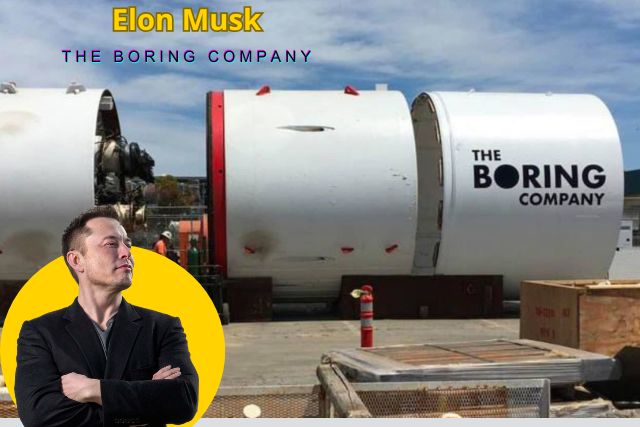
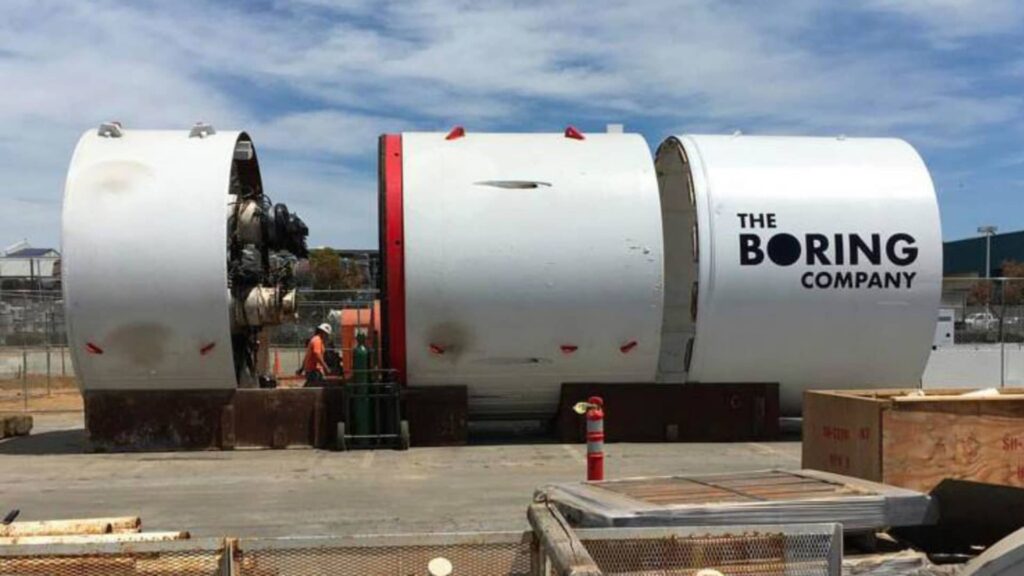
The engineering breakthrough that makes this vision plausible is Prufrock, TBC’s flagship tunnel boring machine.
Traditional boring machines alternate between two phases, digging forward and then stopping to install concrete tunnel lining. Then, in a stop-start rhythm that severely limits throughput.
Prufrock eliminates that limitation entirely by performing both operations simultaneously, never pausing its forward progress.
At the machine’s front end, a rotating cutter head powered by four heavy-duty electric motors, carves through earth with enormous torque.
Excavated material feeds through a muck chamber onto a mile-long conveyor belt that carries debris to the surface.
Behind the cutter head, a remotely controlled liner truck delivers 4,000-pound precast concrete segments; a robotic crane and erector arm then place each segment precisely into the tunnel wall while the machine continues advancing.
A global operations control center allows engineers to monitor and manage machines from Las Vegas to Dubai in real time.
The result is a shift in scale from miles per year to miles per week. A transformation that TBC says is essential to making tunnel infrastructure economically viable for widespread urban deployment.
Las Vegas Loop proof of concept at scale
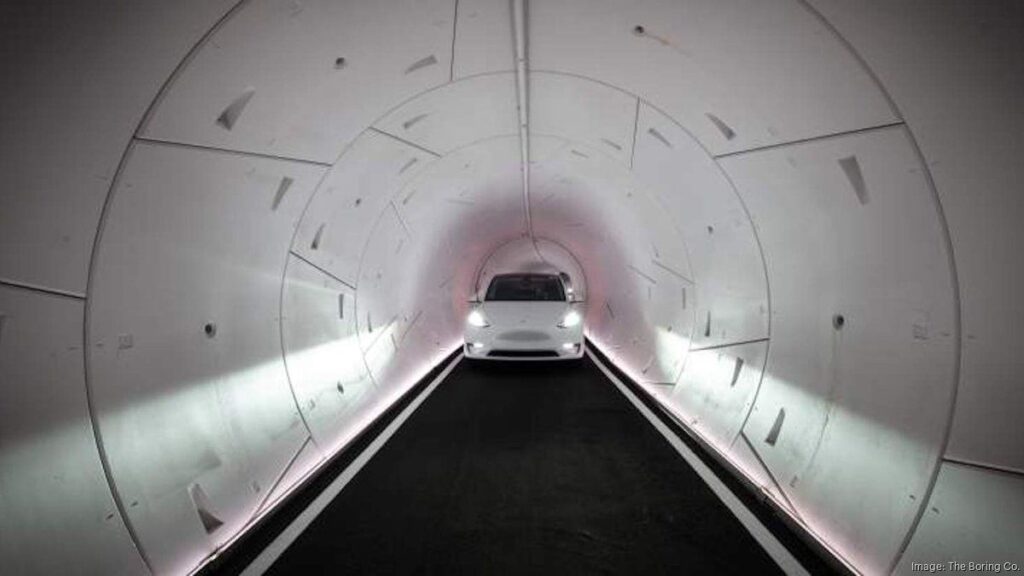
The Vegas Loop is The Boring Company’s most visible achievement to date. Connecting the Las Vegas Convention Center to hotels, casinos, and entertainment venues along the Strip.
The network transports passengers in autonomous Tesla vehicles through a system of underground tunnels, dramatically cutting trip times that would otherwise require navigating the city’s notoriously congested surface streets.
The company has now completed a total of eight miles of tunneling, with the Vegas Loop representing the world’s first operational commercial deployment of this transport model.
Plans to extend the Vegas Loop to Harry Reid International Airport and eventually to connect virtually every major destination on and off the Strip.
Hence, would make it one of the most comprehensive privately operated urban transit systems in American history.
Nashville and beyond the national expansion
Beyond Nevada, TBC has signed a construction contract to build a 13-mile underground loop linking Nashville’s international airport to the heart of downtown.
The project promises to reduce what can be a grueling surface commute to approximately 10 minutes in dedicated Tesla pods.
A journey that currently takes up to 45 minutes during peak hours. Tennessee’s state government has backed the project as a transformative piece of the region’s long-term infrastructure strategy.
The company has also fielded inquiries from municipalities across the United States and internationally, signaling that the boring-as-a-service model is gaining serious traction with public-sector decision-makers who see tunneling as a complement to, rather than a replacement for, conventional mass transit.
The Hyperloop, the long game
If the urban loop projects represent The Boring Company’s near-term ambitions, the Hyperloop represents its most audacious long-range goal.
Originally conceived by Musk in a 2013 white paper, the Hyperloop concept involves propelling passenger pods through low-pressure tubes at speeds exceeding 600 miles per hour.
Thus, connecting city centers that are hours apart by car or plane in a fraction of the time.
The Boring Company’s tunneling expertise positions it as a natural builder of the underground or at-grade infrastructure that a Hyperloop network would require.
While full city-to-city Hyperloop deployment remains a long-horizon objective. TBC’s iterative progress from research tunnels to the Vegas Loop to Nashville, traces a credible engineering path toward that eventual reality.
A new industry is emerging
What The Boring Company has demonstrated, perhaps most importantly, is that tunnel construction need not be the exclusive domain of slow-moving government agencies or legacy engineering conglomerates.
By coupling rapid iteration, vertical integration with Tesla’s autonomous vehicle platform, and a software-driven operations model, TBC has introduced competitive pressure to an industry that has seen little fundamental innovation in decades.
Musk has publicly encouraged rivals to enter the tunneling sector, noting that The Boring Company remains almost uniquely serious about the opportunity.
That challenge and the scale of the urban congestion problem it seeks to address. Notably, suggests the real story of underground transportation may only just be beginning.