Kenyan Scientist Redefining Battery Research in Germany
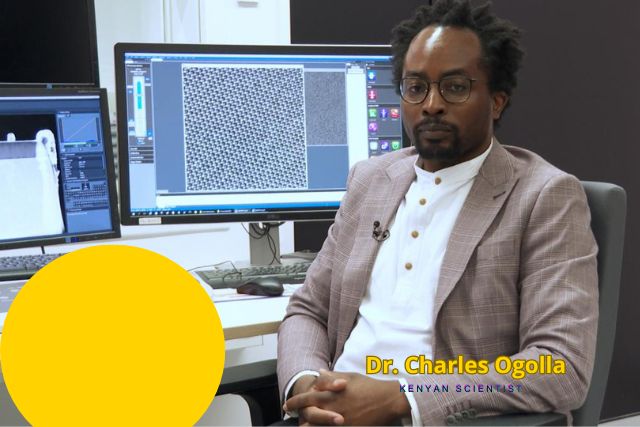
Dr. Charles Ogolla from Kenya is using atomic-level microscopy at the University of Siegen to develop longer-lasting, more efficient batteries for a greener future.
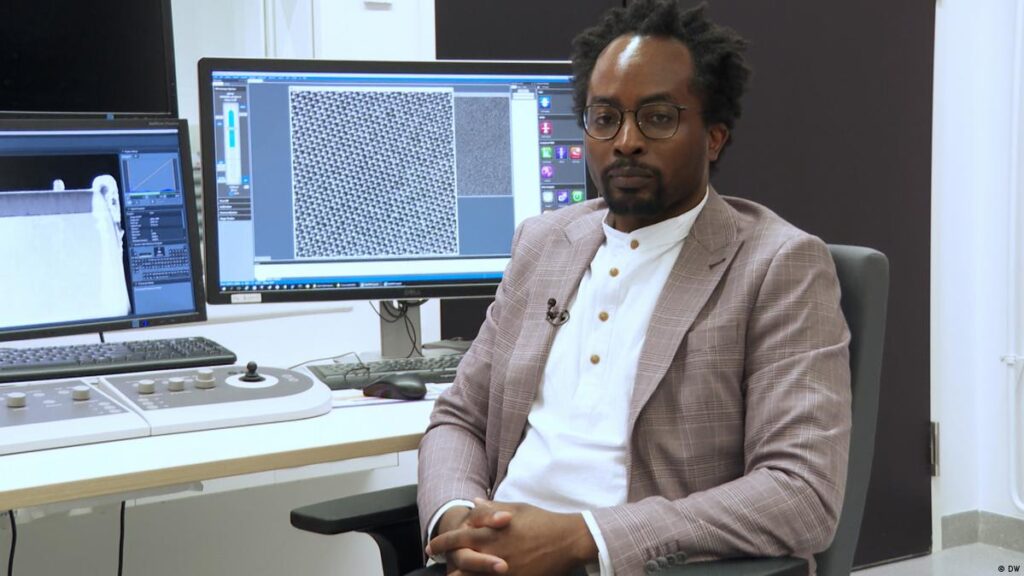
In a high-tech laboratory in Siegen, Germany, where temperatures drop to near-absolute zero and microscopes peer into the atomic architecture of matter, Dr. Charles Ogolla is conducting research that could reshape how the world stores energy. The 36-year-old Kenyan scientist is a lead researcher at the University of Siegen’s Centre for Nano Analytics, Nanochemistry and Cyber-Physical Sensor Technologies. An institution backed by more than 100 million US dollars in state funding and equipped with some of the most sophisticated scientific infrastructure in Europe.
Growing up in Kisumu, Kenya, Ogolla was sharply aware of the financial pressures his family faced. Yet those constraints only sharpened his resolve. “I had my dreams and I really pursued them heavily,” he has said. “I knew that education would pay off one day.” That conviction carried him across continents, and in 2016 he arrived in the western German state of North Rhine-Westphalia to join a university that would soon become his scientific home.
“If there is one quote I find quite inspiring, it is to learn to be comfortable in uncomfortable situations. Learning to be comfortable in uncomfortable situations can really push you to levels you never dreamed of.” — Dr. Charles Ogolla, University of Siegen
Seeing the invisible with research at the nanoscale
Dr. Ogolla’s work centres on improving energy storage by examining how minute, microscopic modifications can produce significant gains in battery performance. Using highly specialised cryo-electron microscopes, he and his colleagues observe the atomic structures inside battery materials. Notably, imaging at a scale almost unimaginable to the naked eye. These cryogenic conditions allow the team to study how chemical systems behave at the nanoscale without disturbing their natural state, yielding insights that conventional experiments simply cannot provide.
His framing of the research is deliberately accessible. Imagine needing two batteries to power a household torch, he suggests. If advances in materials science could achieve the same output from just one, the benefits would ripple outward: lower consumer costs, reduced manufacturing demand, and less pressure on the raw materials supply chain. It is an elegantly simple vision built on extraordinarily complex science.
Reducing reliance on critical minerals
The implications of Ogolla’s research extend well beyond the laboratory. Many of the batteries powering everyday devices from smartphones to electric vehicles, rely on lithium and cobalt, minerals extracted predominantly in countries such as the Democratic Republic of Congo. The human and environmental cost of that extraction has drawn growing international scrutiny. Dr. Ogolla is clear about his work’s potential contribution: more efficient battery systems would reduce the quantities of these essential elements required per unit of energy stored, directly easing the pressure on mining operations and the communities they affect.
“My contribution to getting efficient battery systems would then reduce the need for essential elements such as lithium and cobalt, reducing the pressure and the mining needs.”
— Dr. Charles Ogolla
A historic distinction and a call to invest
In a milestone that underscores the calibre of his work, Dr. Ogolla recently defended his doctoral thesis with the highest possible academic distinction, Summa Cum Laude. He is the first researcher at the Siegen centre to receive that honour. A remarkable achievement in any scientific context and a powerful signal to the broader African research community about what is possible when talent meets opportunity.
Yet Ogolla is candid about the conditions that make such outcomes possible. “Support, in my view, is infrastructure,” he says, gesturing to the advanced equipment surrounding him. “It’s not only academia, governments need to come in and support research heavily.” His message is not one of complaint but of strategic clarity: African nations with ambitions to compete in the green energy transition must invest in the tools and institutions that allow their scientists to do frontier-level work.
Language, too, proved transformative. After arriving in Germany, Ogolla spent a full year dedicated to mastering German before resuming his academic work. “It opened quite a lot of doors,” he reflects. “Where I needed support, I could really express myself properly.” That willingness to embrace discomfort linguistic, cultural, scientific is perhaps the most consistent theme in his story.
Africa’s stake in the green energy race
Improved energy storage technologies are foundational to the global shift toward renewable energy. Without better batteries, solar and wind power remain intermittent. Powerful when conditions allow, but unable to reliably serve as base-load alternatives to fossil fuels. Dr. Ogolla’s work sits squarely at this intersection of materials science and energy policy, making his laboratory in Siegen a genuinely consequential place.
As a father and a scientist who has travelled from western Kenya to one of Europe’s foremost nanoscience facilities, Ogolla carries his journey with evident purpose. His trajectory is proof, he believes, that African scientists are not waiting in the wings of the green energy race. They are already running it. The challenge now is to ensure the infrastructure, funding, and institutional support exist to bring many more alongside him.
Dr. Charles Ogolla is a PhD researcher at the University of Siegen’s Centre for Nano Analytics, Nanochemistry and Cyber-Physical Sensor Technologies, in Siegen, Germany.